
 |
 |
 |
|
PLEXUS CURVILINEAR VISION: NON-LINEAR, NOT-IN EQUILIBRIUM, DISCONTINUOUS, NURAGIC RECALL COMPRESSIONIS
TIME IS
ONLY A RIDDLE
OF GRAVITATION BY OUR MIND
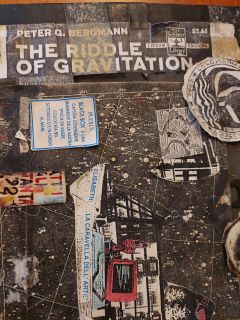
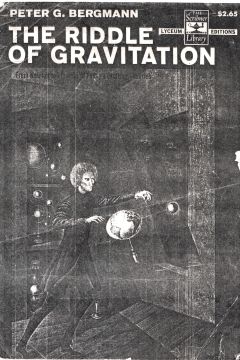


PAST-PRESENT-FUTURE?
JUST ONE FRAME
"A frame is a data-structure for representing a stereotyped situation."
Marvin Minsky, A Framework for Representing Knowledge, 1974
PLEXUS CURVILINEAR VISION: NON-LINEAR, NOT-IN EQUILIBRIUM, DISCONTINUOUS, NURAGIC RECALL COMPRESSIONIST
Plexus Compressionism Process is “a quick shorthand, is jazz compressed in a magic music art form, is no time to move, is a nanosecond, is one plus one equals three, is speed up time, is creative process, is Plexus process, is computer chip, is critical mass, is yang no ying.

Leonard Horowitz, Cultural Civic Center C.U.A.N.D.O., Lower East Side, NYC, 1989

PLEXUS CURVILINEAR GEOMETRY OF CONSCIOUNESS

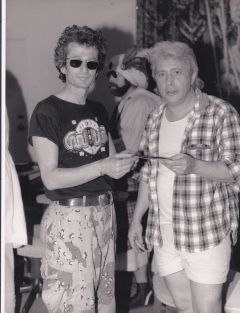
Who killed Henrich Hertz? George Chaikin and Sandro Dernini, 1987
George Chaikin, Sandro Dernini, in front to Albert Einstein's Home, Princeton, 1989
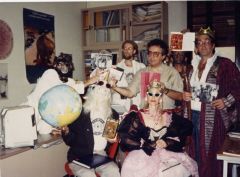
PLEXUS VIAGGIO NEL PIANETA ARTE Sandro Dernini, Steven DiLauro, Willem Brugman, David Boyle, Franco Meloni, Antonio Caboni, Sarah Jackson, Dept. of Physics, University of Cagliari, 1989
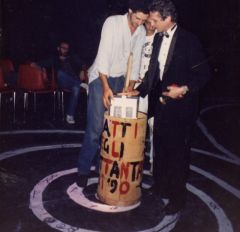
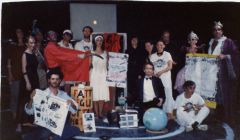
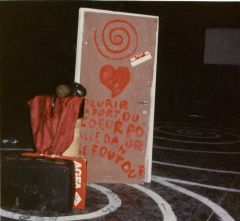
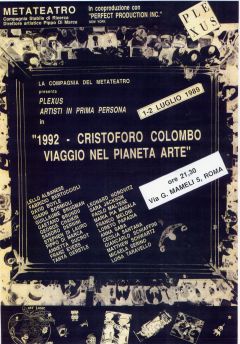
Open the Door of your Heart to go into the future by Fabrizio Beruccioli
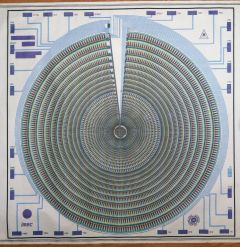
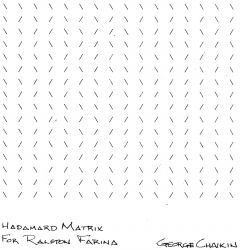
1992 Christopher Columbus Viaggio nel Pianeta Arte", Rome, 1989
Hadamard Matrix Why it is Art
by George Chaikin
...It’s art because it is recursive. I’ll bet you never heard this one before, but I’m sure you’ve encountered the concept. It means that drawing contains its own reiteration at a different scale – this is fundamental to its algorithm – that it is defined in terms of itself on a different scale...

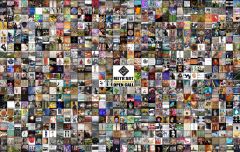
by Leonard Horowitz, New York, 1989
I first experienced ‘compressionisme’ in the Spring of 1985, where I was suddenly engulfed by a “Total Theatre” environmental spectacular Opera called “Goya Time,” a byand extremely compressed dramatization of three paintings by Francisco Goya: “The Nude Maja,” “The Royal Family,” and “The Eight of May.” This avant garde “Co-opera” was conceived, produced and directed by Dr. Sandro Dernini, an accomplished biologist from the island of Sardinia, in collaboration with Gretta Sarfaty and Lawrence “Butch” Morris. By dramatizing these three Goya painting and having this cast of Goya costumed artists literally run through the audience, it destroyed the normal sense of separation of staged theatre, since all at once you were not only the observer, but a participant. In order to really catch the total and unexpected actions taking place, one had to constantly shift one’s view from the Royal family on the balcony and further physically follow their descent through the amazed milling crowd below. The Royal Family pushed their way through the packed gymnasium, past thirty artists doing their simultaneous versions of the Nude Maja, and brushed past me, almost knocking me down. The whole spectacle was tied together and totally reified by modular music created and conducted and orchestrated by Butch Morris and further amplified by the dancing of Gloria McLean and company. The whole Opera lasted an hour chronologically ....but...psychologically seemed to be over in ten minutes. So we can say that because of the concept and the simulsensuous presentation, that there was an intense compression of time, of events, of experience, of total unexpectedness. If one agrees with the theory that art should contain elements of surprise, then this plexus process and operas by Robert Wilson, by Meredith Monk and the Ontological-Hysterical process of Richard Forman is that Robert Wilson, Meredith Monk and Richard Forman tend to suspend time, to Surrealize it, and certainly in Robert Wilson work, to stretch time into a suspended “Dream State,” a psychedelicate state. If we have been subconsciously influenced by the motion picture (and now television), as I believe we all are, then the obvious differences between the plexus process and especially any of Wilsons masterpieces (Einstein on the Beach) is that Robert Wilsons oeuvre has a strong sense of slowed motion and Plexus has the quality of Pixillation, of jump cut, of extreme compression. A Polish mathematician, Klaus Wyborny, working in Hamburg, Germany, a number of years ago (and using a timing devise on his camera), automatically pixillated frames from Citizen Kane and compressed this famous film into three minutes! The result is a very short film that compresses the images to the extent that the people disappear and the images are transformed into an atomic type mushroom cloud with a peculiar black dot that seems like an insect flying in and out of the cloud. This is a transformation of the original classic into a totally abstract process and sculptural vision. And that has been the Plexus Process, whether we have dealt with the theme of Dante’s Purgatorio, with the symbolic universal Serpent and with Eve in the Garden of Eden. The very idea of “Modern Art” has to do with this ‘compressionistic’ process, since time certainly speeded up psychologically and physically for the French Impressionists, who invented modern art by: Improvising, by having a speeded-up moment to moment interaction with the last brush stroke and with the reified overall effect. They did it to the extent that the real subject matter of all modern art becomes the process itself, and any visual subject matter really becomes a vehicle employed in this amazing compressionistic process. (The tail wags the dog). No painter who has been sensitive and aware of “Whats been going on” has failed to be positively influenced by this direct improvised process. If we draw a line from the cubist space of Cezanne, we can extend this modern compass through Picasso and into the New York School of “Action-Painting,” the so called Abstract Expressionism, especially early DeKooning. We can draw another line from Gaugin through Matisse and into Colour Field painting, into more interactive colour-shapes in space. This flattening out of the picture plane not only compresses space, but... returns it to a universal ‘primitive’ sense as envisioned by Gaugin and even Mark Rothko.
(If you have a guest and a host, then you have a GHOST... Marcel Duchamp)
Plexus Compressionism Process is “a quick shorthand, is jazz compressed in a magic music art form, is no time to move, is a nanosecond, is one plus one equals three, is speed up time, is creative process, is Plexus process, is computer chip, is critical mass, is yang no ying.

PLEXUS CURVILINEAR GEOMETRY OF CONSCIOUNESS
Who killed Henrich Hertz? George Chaikin and Sandro Dernini, 1987
George Chaikin, Sandro Dernini, in front to Albert Einstein's Home, Princeton, 1989
"1992 Christopher Columbus Viaggio nel Pianeta Arte", Rome, 1989
Hadamard Matrix Why it is Art
by George Chaikin
...It’s art because it is recursive. I’ll bet you never heard this one before, but I’m sure you’ve encountered the concept. It means that drawing contains its own reiteration at a different scale – this is fundamental to its algorithm – that it is defined in terms of itself on a different scale...

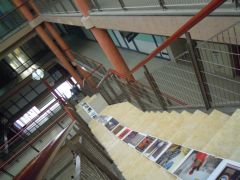
PLEXUS METR'ART
Plexus Metr'Art, is a monumental historical work of contemporary art, made up of 390.94 meters of original photocopies, from 2004-2019, of 935 digital works (jpg), by 469 artists from all over the world as their contribution to the
Plexus Open Calls
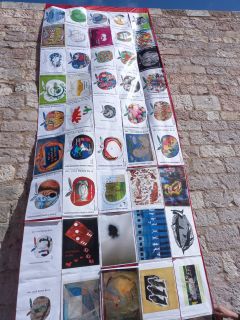

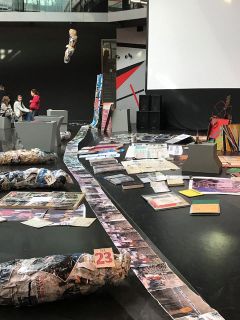
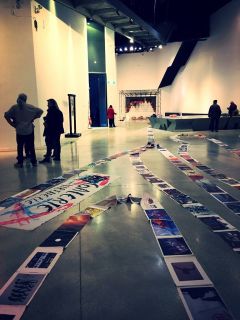


THE VOYAGE OF THE PLEXUS METR'ART
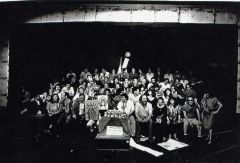
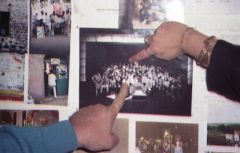
The idea to bring together photo group shots for the Plexus "Art Slavery Manifesto," challenging the commodification of art, was conceived in 1988 by Lenny Horowitz as a a compressionist art work of group shots, containing other group photos, which contained other photos of Plexus historical art journey and so on more, as frames also refering to other frames showing other photos as direct quotes of them.
PLEXUS Art Slavery Manifesto Group Photo Shots


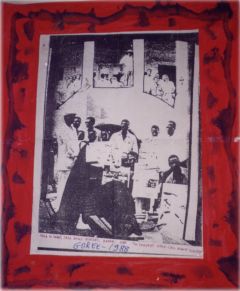
1988 PLEXUS MANIFESTO ART SLAVERY, HOUSE OF THE SLAVES, GOREE-DAKAR
Plexus Compressionism very interconnected frames of references of other references, direct verbal and pictorial quotations to be accounted in a proper interpretation (Then a photograph may actually contain a duplicate of a second photograph; and the first, if it also refers to the second through showing it as in a frame, etc., might then be said to quote it directly


Photos by Anna Marceddu




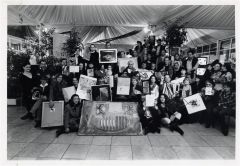






Plexus compressionist fractal frame.




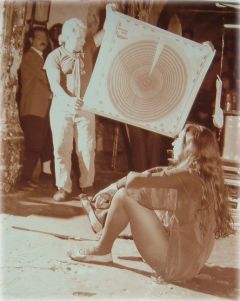

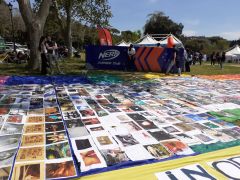
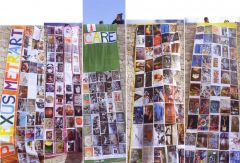
PLEXUS METR'ART PLEXUS METR'ART
"Open the Door of your Heart to go into the Future", installation by Fabrizio Bertuccioli, at the art opera "!992 Cristoforo Colombo, Viaggio nel Pianeta Arte", Metateatro, Rome, 1989
The closing of Plexus into a black box by Sandro Dernini, Giancarlo Schiaffini,Fabrizio Bertuccioli, Roberto Federici, Antonio Caboni, Stephen DiLauro, Willem Brugman, Micaela Serino
Time has speed up and there is no time left for aesthetic distance between the artist as performer and the art observer.

"PLEXUS" DEFINITION
Anatomy: a network of intersecting nerves or blood/lymph vessels (e.g., brachial plexus, solar plexus).
General: any complex, interwoven network, any interlacing of parts
The solar PLEXUS is a complex of PLEXUS, CHAKRAS, connecting billions and billions of individuals cells as a whole living organism, the human being, able of reproduction, of growing, of modifications of thinking, and transmitting culture.

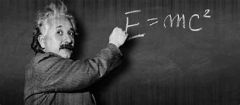
Time Is now the 4th dimension. "Time-Space" has changed "Logic"
One Nanosecond Is a billion fractions of one second. It Is the time with what are working our logical computers, It Is the time measured before to be able to think It. It Is the a-rational time that exist before Its thinking, and Its cartesian dependence of "Coglto ergo sum"
What you feel and see is your own creation…
We are called PLEXUS.
"Mytho-Compressionism”
Leonard Horowitz, 1986,New York
Over the years Plexus events have built one upon the other. Each event takes place in its own present but it is made up of past concepts and activities while it projects its own various parts into its future activities.




 Feed RSS